When 1,500 Stockport residents marched to Peterloo
By Stockport Heritage Trust 26th Aug 2026


By Jill Trumble
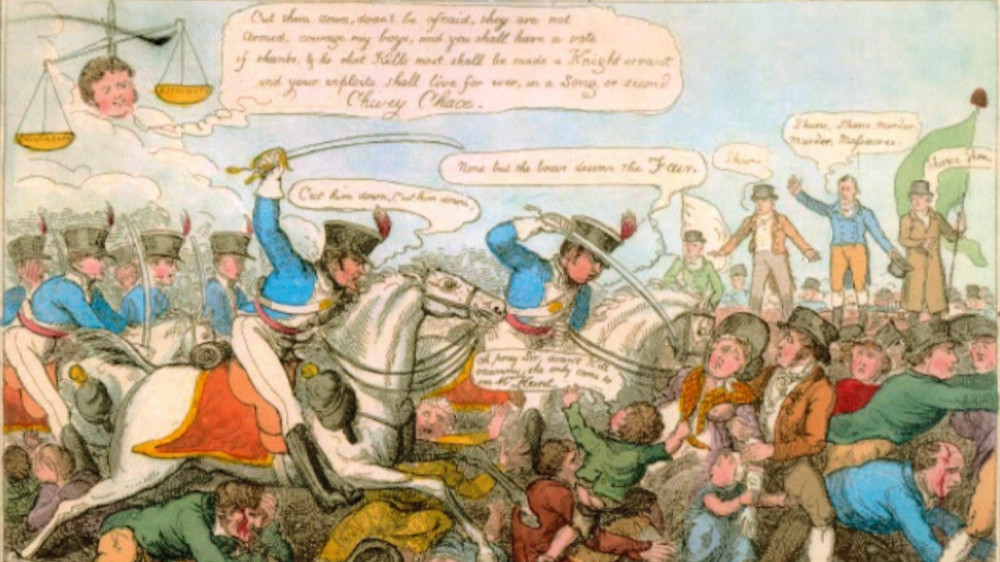
Sunday 16 August marked 207 years since the Peterloo Massacre, when mass crowds assembled on St. Peter's Fields in Manchester.
Men, women and children from all over the north-west gathered to hear the Orator, Henry Hunt, speak against the Corn Laws and for parliamentary reform. Around 1,500 people from Stockport marched peacefully to the site on that hot summer morning in 1819.
Discontent had been brewing in Stockport for many years. Circumstances for ordinary people had been deteriorating during the Napoleonic Wars which raged from 1793–1815 and the authorities were fearful of uprisings in the country in the wake of the French Revolution.
There was rioting over food prices as early as 1795. Volunteer militia were formed to support the magistrates and yeomanry in case of local unrest from around 1800. In Stockport, loyalist associations such as the Stockport Loyal Volunteers assisted the authorities in cracking down on the activities of local radical groups.
In April 1812, Stockport experienced Luddite riots when several factories, and the homes of some factory owners, were attacked by an estimated 3000 rioters from Hyde and Gee Cross. A voluntary subscription was raised to sell food to the poor at a reduced rate to try and stave off protests.
Problems really started coming to a head in the years before and after Waterloo when soldiers were returning home to find there were no jobs for them and the Corn Laws of 1815 enforced trade restrictions to keep prices high to favour domestic producers. This kept the price of bread inflated and benefitted aristocratic land owners. Mill owners were against the Corn Laws, but only because it affected their wage bill.
From 1816 onwards there was a slump in the cotton industry and the discontent grew worse. Stockport became a hotbed of extreme radicalism. 1818 was a very busy year for the radicals who were based in rooms inside the windmill that stood on the site of Hollingdrakes old showroom, a day and evening school was established there.
Download our Nub News App!
- It’s FREE and available now- Breaking news notifications
- Your Town in Your Pocket


In July 1818 there was violence from both sides when dressers and power loom weavers went on strike and cavalry were brought from Manchester to quell the rioters. One of the Stockport Yeomanry and a constable charged up Hillgate and attacked the house of Dr. Thomas Cheetham, a radical sympathiser, whose house was located somewhere near to the old Salvation Army building.
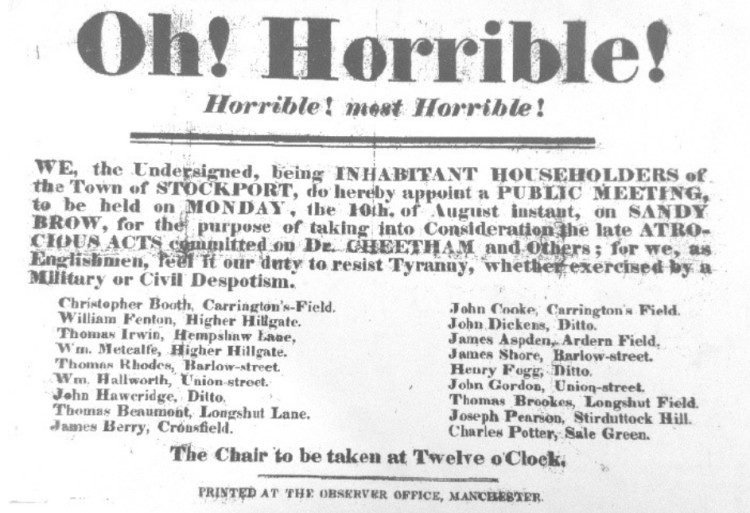
This Yeomanry officer was a sergeant in the Stockport Yeomanry Cavalry who later served at Peterloo. He slashed at the front door of Dr. Cheetham's house with his sabre, then fired his pistol through the keyhole and also damaged the windows. Dr. Cheetham, his family and visitors escaped injury. The officer was described as 'a butcher of Peterloo' in a note included in the St. Mary's memorial inscriptions.
A Female Reform Society was formed which met at the Windmill Rooms, although women had shown their support to the radical cause long before this. The newly formed Union for the Promotion of Human Happiness later set up their headquarters there. One of its primary aims was to raise money for three jailed local radical leaders.
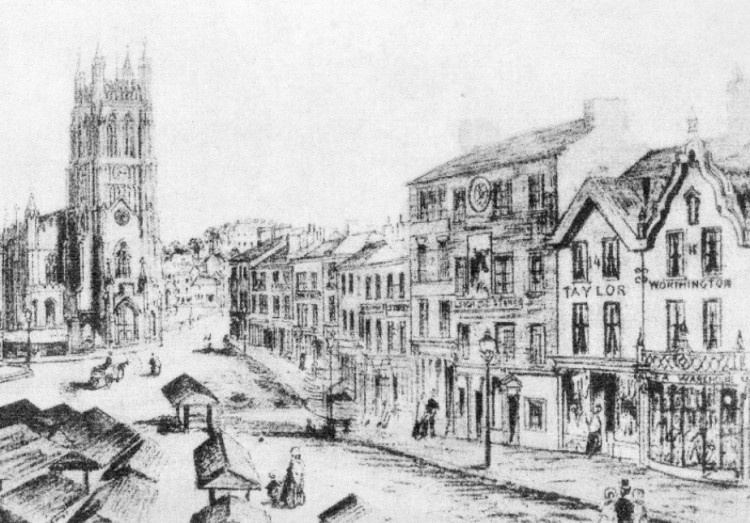
In January of 1819, Henry Hunt was invited to speak in Stockport for the Radicals. 'Orator' Hunt, the main speaker at Peterloo, gave speeches from the upstairs balcony of the Bull's Head in the open Market Place, against the Corn Laws and for parliamentary reform. He had the ability to draw extensive crowds around to listen to his speeches.
On the 15th of February 1819, the Radicals, in an event that became known as the Sandy Brow Riot, routed the Yeomanry at Sandy Brow (roughly in the area where the roundabout on Piccadilly now stands.). It was one of the most important radical meetings in 1819 and ballads were subsequently written about it.
The purpose of the meeting was to consider whether or not to send a petition to the Prince Regent, as well as to protest against the arrests of local radicals. A crowd of around 6,000 reformers carried two banners to Sandy Brow calling for 'no corn laws' and 'the rights of man'. The authorities saw this meeting as seditious and needed to be dispersed.

Under the command of Clerical Magistrate Rev. Charles Prescot, five constables on horseback, rode their way through the crowd, striking people as they went and attempted to pull down the Cap of Liberty from the crowd. Unwilling to give up such an important radical symbol, the crowd fought back and a tussle ensued.
The crowd forced the militia to flee by throwing brickbats, stones and mud. Rev. Prescot read the Riot Act three times before the triumphant crowd finally went home late in the night, singing the popular song "Millions be Free!". It was the first time in the country that a crowd refused to be dispersed after the reading of the Riot Act.
This event was reported to the Home Secretary, Lord Sidmouth, with a comment made that these meetings 'will be followed up no doubt by the next step of a general rising'.
The brutality of the Stockport militia at Peterloo may be attributed to their desire to get their own back after their defeat at Sandy Brow.
A further event in 1819 was to have a massive influence on the suspicions of the authorities when Constable William Birch was shot in the chest in Loyalty Place. On July 23rd 1819, after returning to Stockport having arrested two men for sedition, he secured them in his own house but word got out and a crowd of radical supporters gathered.
He had left his house to seek advice from the magistrate's clerk, John Lloyd, who was not at home and on Birch's return he was approached by two men, and was shot in the chest by one of them, Jacob McGhinness, a weaver from Edgeley.
Birch sought the help of the surgeon, Dr. Killer, who could find no pistol ball in his chest. William Birch was then taken undercover, by sedan chair, to his father's house opposite the Queen's Head in Little Underbank.
At the time, some people had doubted that there had been a bullet wound at all but the bullet had lodged in his breastbone and caused his lung to deteriorate causing his death 15 years later. It was removed from his body and is now on display in Staircase House.

McGhinness escaped and fled to Ireland. He was later found in his aunt's bed wearing a woman's nightgown and cap, and was arrested and taken to Chester for trial, where he was sentenced to death. In his memoirs, he stated that he never intended to shoot William Birch, rather it was his intention to shoot John Lloyd.
This was just three weeks before Peterloo.
The meeting at St. Peter's Fields had originally been planned for 9th August, but was deemed to be illegal and was therefore postponed.
On 16 August, the people of Stockport made their way to Manchester, arriving between 1-2pm. It was reported by the magistrate, Francis Philips from Heaton Mersey, that the people, around 1500 of them, both men and women, were marching in an orderly fashion, wearing their Sunday best. The Stockport contingient were close to the hustings where Henry Hunt was to deliver his speech.
The Manchester magistrates were fearful of the massive crowd that had gathered from all over the north west and ordered the arrest of the leaders on the hustings including Henry Hunt. But after the arrests, the Manchester Yeomanry, many of whom were drunk, charged onto the field.
They had only recently been formed and were inexperienced, and on horses that had not been trained in crowd control and attacked the crowd with sabres. Regular troops were sent in to disperse the crowd. The Cheshire Yeomanry became involved in the melèe and came away with two banners which John Lloyd publicly burnt in the Market Place declaring that the Yeomanry 'had returned with honour'.
The tragic events of that day were over in a matter of 20 minutes.
Fifty Stockport people who were casualities received small amounts of compensation, the injuries sustained were mostly caused by being trampled by the cavalry, being hit by a sabre or crushed in the crowd. There were probably others who did not report their injuries to the authorities for fear of losing their jobs. No-one from Stockport was killed. However a young man received blows to his forehead causing part of the bone to be cut away, later gave evidence in a trial opposing the authorities. The bone was displayed by Henry Hunt in the House of Commons in 1831.
Stockport had a night patrol with an average of eight different individuals patrolling their areas each night. They were mostly local tradesmen and manufacturers who undertook this task in order to protect their own and their neighbours businesses. About three quarters of them had some connection with loyalist organisations and a handful were deeply involved.
Lists covering the period from 30th August to 27th December 1819 and covering six different areas, are in Stockport's historical archives.
Stockport and it's inhabitants, Loyalists and Radicals alike played their important roles in the events leading up to Peterloo.
~
Those interested in learning more about Stockport's heritage can visit the heritage centre Tuesday 11am – 2pm and Saturday 10.30 – 2pm. The centre is situated inside St. Mary's Parish Church, Market Place, on the left hand side past the cafe.
The heritage trust also opens the former courthouse and dungeon to the public on the second Saturday of every month, from 10.30am until 3.30pm, or when the last visitor leaves.
The trust's website can be found HERE.
Download our Nub News App:
- It’s FREE and available now
- Breaking news notifications
- Your Town in Your Pocket

Share: