Greater Manchester’s £1 billion congestion problem
By Declan Carey - Local Democracy Reporter 4th Nov 2026
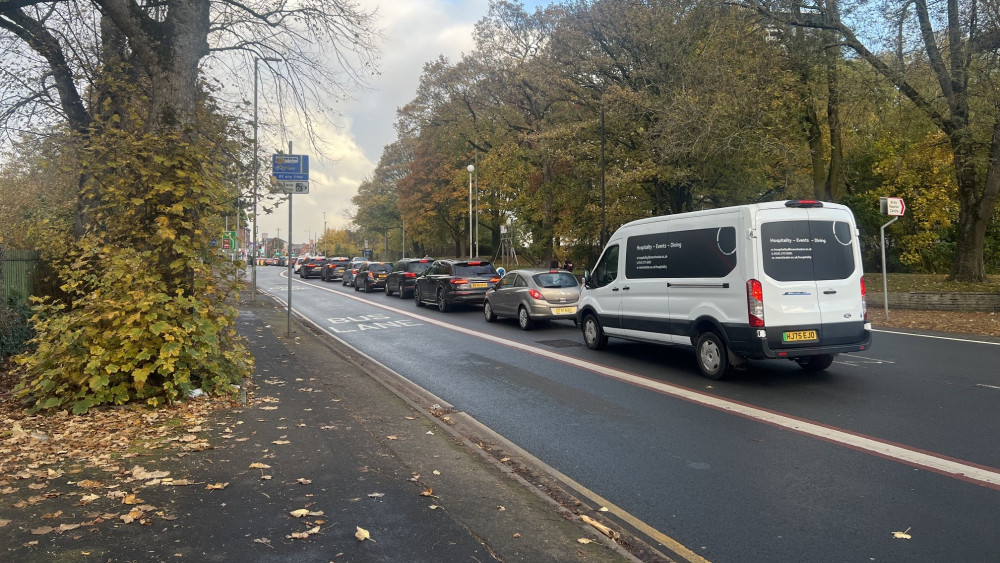


Transport bosses in Greater Manchester say there are no plans for a congestion charge in the city centre amid concerns traffic levels across the region are getting out of hand.
A report published by Manchester council on Tuesday (November 3) revealed traffic has become so bad that it is sucking billions of pounds out of the region's economy – on top of causing issues with delays and air quality.
Transport for Greater Manchester (TfGM) said it will 'invest heavily' in public transport to try and turn the situation around, with £2.5bn of government money set to flow into the region between 2027 and 2032, and plans to bring railway lines into the Bee Network starting from this December.
A TfGM spokesperson added: "There are no plans for a congestion charge in any part of Greater Manchester, instead we are investing heavily in the Bee Network to give people a reliable alternative to getting in their car.
"One tram full of people could replace around 200 cars on the road and a double decker bus around 75, demonstrating the benefits of getting more people on board the Bee Network."
Investment in public transport has long been viewed as the solution to improving congestion in Greater Manchester, but some have questioned whether the approach is working.
Councillors in Manchester clashed over the issue at a scrutiny meeting on Tuesday (November 3).
Reform UK Councillor Dylan Evans argued that creating more cycle lanes could make congestion in Manchester even worse.
Download our Nub News App!
- It’s FREE and available now- Breaking news notifications
- Your Town in Your Pocket


He said: "There's going to be less space if we're putting more and more cycle lanes on certain roads which leads to congestion, because there's less space then for cars.
"In an ideal world, I'm sure we'd all love to snap our fingers and everyone cycles and we all have a very good time, but that's not the reality."
Labour Councillor Mandie Shilton Godwin, who leads on transport issues in Manchester, said the focus had to be on improving walking, cycling and public transport options.
She added: "Everything that we do, the number of cars and the number of car journeys does seem to inexorably increase, and that is very unfortunate, because the space we have is the space we have, and if you have a car, it won't fit in a smaller space.
"That is very difficult for everybody."
A Manchester council report put the cost of the region's congestion issues at £1.3bn a year to the economy.
The council document explained that congestion in Manchester is back to pre-pandemic levels, and that a 'key priority' for the town hall is to encourage more people to ditch their cars for active travel instead.
While a recent TfGM report found that traffic levels in Greater Manchester are three per cent above 2019 levels.
Cities around the UK have looked at different ways of fixing congestion on the roads.
Transport for London (TfL) said that when the capital's congestion charge was introduced in 2003, traffic levels dropped and public transport usage went up.
A TfL spokesperson said: "When the congestion charge was introduced in 2003, there was a 30 per cent reduction in congestion within the zone and a 15 per cent reduction in circulating traffic in the first year.
"It also boosted bus travel by 33 per cent.
"Analysis has shown that there would have been around three million additional journeys by car across London in 2019 without the changes TfL has introduced to encourage more sustainable travel patterns over the last two decades, of which the congestion charge was a critical first step."
Greater Manchester's own traffic problems have grown amid a major boost in housebuilding around the region, and especially in the borough of Manchester itself.
Building thousands of new homes has brought new residents to the region, all of whom need a way to get around.
A Manchester City Council officer said at Tuesday's scrutiny meeting that the city's 'Victorian' roads could only be expanded so much given the city's growth.

They added: "Given our growth forecast in terms of jobs and the number of homes that are being delivered across the city, we know we have to do something to prepare for a modal shift, because just to continually seek to accommodate an ever-increasing number of cars isn't feasible.
"We've got a lot of narrow Victorian roads, there is a limit to what we can do to widen them.
"What we are trying to do is to provide reliable, alternative, safe options. Separate cycling and walking lanes increase people's confidence to use those as options."
A spokesperson for Manchester council said: "We have known for some time that Manchester is reaching the upper limits of how many vehicles can be accommodated by the current network.
"The continued growth of the city coupled with the increase in car ownership across the city-region contributes to a situation where more cars are competing for the same amount of space on our roads.
"The council – alongside our GM partners – have been working to address this issue in recent years with a concerted push towards other forms of transport which can remove pressure from the road network.
"We are investing in public transport as well as walking and cycling infrastructure in order to provide more ways to travel, so that journey times can be more reliable for when driving is the best option."
Download our Nub News App:
- It’s FREE and available now
- Breaking news notifications
- Your Town in Your Pocket

Share: