
New data centres are being built in Reddish
By Alasdair Perry 12th Aug 2026
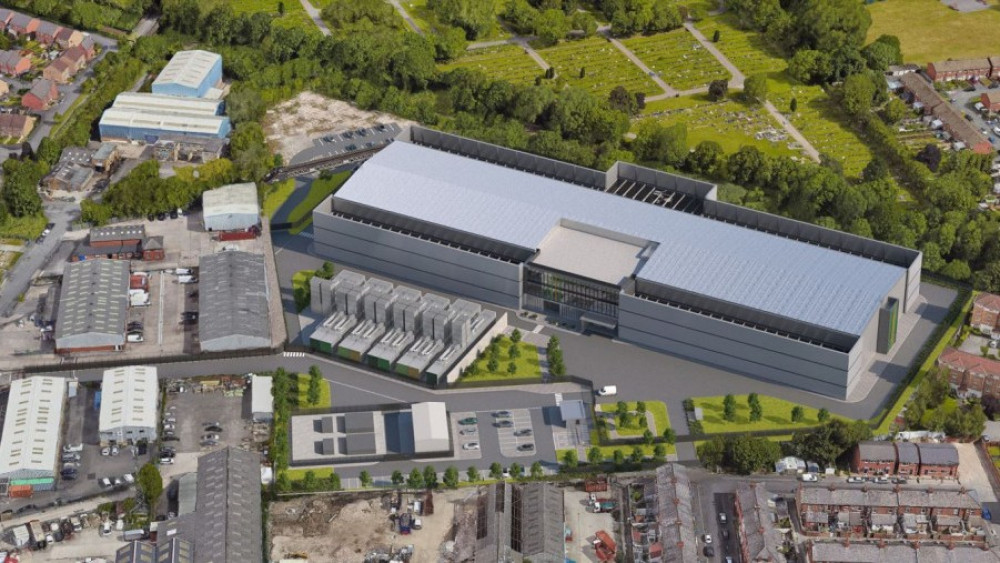


Behind a row of terraced houses in Stockport, something big is happening.
Residents in Reddish first noticed when they saw the trucks bringing rubble from the site of a former concrete works, which is hidden behind large blue construction hoardings.
The old concrete manufacturer in the area had been closed for years, having last been in operation in 2021.
But in March 2024, Stockport council's planning committee approved plans to demolish the former industrial complex and replace it with what is said to be northern England's biggest data centre, at 25,900sqm.
It is based on Kenwood Road, but the boundary of the land stretches behind several residential streets.
The mammoth project will cost £350m and bosses at Kao Data, the firm behind the project, say it could put Greater Manchester on the radar of 'global technology firms' looking for their next base.
Data centres are essentially the physical machines which store, manage and process online data.
This matters because pretty much anything done online these days uses or processes information, from sending a message to streaming a television programme, and all that information has to be physically stored or moved through somewhere.
Download our Nub News App!
- It’s FREE and available now- Breaking news notifications
- Your Town in Your Pocket


There are already large data centres dotted around the country, mostly concentrated on the outskirts of London.
But Greater Manchester is going through a period of data centre expansion, with new buildings being planned around the region, including the one in Reddish.
As for others, councillors in Salford approved plans for a £250m investment for a new data centre in the city in 2025, based near the Salford Community Stadium in Eccles.
When this is built, the data centre will create up to 20 new jobs, with five to ten people expected to be working at the site at any given time.
Councillor Mike McCusker, who was Salford's planning lead at the time, said the building will be 'crucial for our economy and generating the growth we need'.
Plans have also been announced for a data centre in Newton Heath in east Manchester, in a scheme being by Latos Data Centres.
This would mean building the site on a patch of land on the corner of Bower Street and Ten Acres Lane, next to the Rochdale Canal and a short distance from Manchester city centre.
The hope is that new data centres will encourage new companies to 'cluster' in Greater Manchester, close to areas where there is existing infrastructure and plenty of land to build on.

It could bring both jobs and investment to the region if all goes to plan.
But on Carna Road and the surrounding streets in Stockport, people are really worried about what it could mean for them.
Several locals said they're not convinced Reddish is the right place for such a facility, with fears about noise and disruption during construction and afterwards.
Once up and running, the new data centre in Reddish is expected to give out a certain level of noise and be running 24/7.
Planning reports from 2024 suggested that this would be at the level of 'background noise levels', which are expected to have a 'low impact' on the neighbourhood, and far below the noise created from the former concrete works site.
But people living nearby said the noise from ongoing groundworks is already becoming annoying.
"There's noise from there constantly," said 26-year-old Danielle, who lives on Carna Road right opposite where the new data centre will soon be.
Her bedroom faces towards the blue construction hoardings that have gone up around the former concrete works, and she said it's been a hive of activity recently.

She added: "I understand why we need it, but you would think they could make it quieter with a big data centre."
Danielle is not the only one in the area worried by the site.
Sam Rogers, 32, lives on Carna Road and said he's unsure why an urban area was chosen for such a project, rather than somewhere remote.
He added: "There's been low level construction noise coming from the site, but it's not been too noticeable so far.
"We've heard that apparently it might impact the water pressure in the area when it opens, because data centres use so much water."
Data centres are becoming a controversial topic in the world of politics too.
The government designated them as 'critical national infrastructure' in 2024, putting data centres on an equal footing as water, energy and emergency services systems.
But some are sceptical about the benefits of them, and have questioned how environmentally friendly they are.
Andy Burnham visited the Kao Data site in Stockport in 2024 in his capacity as Greater Manchester mayor after it was granted planning permission.
He was massively supportive of the project at the time, saying: "We've been the fastest growing digital and tech hub in Europe in recent years, but if we want that to continue we need to see the emergence of facilities like this.
"This is the first of its kind. There are other, smaller data centres in the city-region, but this is the first large scale, modern, zero carbon data centre in Greater Manchester.
"It will particularly support the development of our AI cluster, we've got the largest AI cluster in the country outside London, maybe the largest overall – six percent of UK AI is based here.
"We want to double in the years to come, so facilities like this and partnerships with Kao Data are going to be huge going forward. There's an opportunity right now for Greater Manchester to become the first big mover in this space in the north of England."
Reddish Councillor James Frizzell, of the Green Party, was less enthusiastic.
While he stressed he's not against the idea of new technologies coming to Stockport, he said it has to be done in the right way, and for the right reasons.
He said: "We weren't particularly happy with first of all its location, and its energy credentials, using diesel generators as a back up, there's no real plan to reuse the heat that it generates, there's concerns about the amount of water that it uses.
"It's not going to create that many jobs either and they're not necessarily going to be local jobs, from memory it's about 40 jobs."
One of his concerns was about what the data centre could be used for.
The buildings have been tipped to be critical for the growing use of artificial intelligence (AI) in everyday life, as companies and individuals embrace the new wave of technology that once seemed from the distant future.
But could data centres be used for harmful things too?
Councillor Frizzell said: "If the computation power that is being used is for the good then that's fine for the good of everyone or advancements or medical technology or other things, but if it's just to generate [AI] images, we've seen things in the press about people being quite badly violated by having AI imagery done of them, which is disgraceful, so would that really be the best use of our energy to create things that aren't helpful?"
Responding, Kao Data said that data centres are essential for modern life.
Director of marketing at the firm, Lizzy McDowell, said: "Every online purchase we make, Whatsapp message we send or Netflix series that we watch relies on a data centre to enable it.
"Beyond this, data centres are also responsible for facilitating biomedical research, scientific innovation, major societal developments and ultimately powering the future."
The company explained that the 'vast majority of data centres' in the UK have been built in and around West London, but the area is 'reaching its limits' in capacity.
They argued that data centres operators are now having to look elsewhere to set up shop, such as Greater Manchester.
Ms McDowell added: "Greater Manchester is well placed to capitalise on this opportunity as there are plenty of well-connected ex-industrial sites and the city region has access to clean and available power.
"Manchester is the fastest growing tech economy in Europe and by having a data centre based here creates yet another reason for tech businesses to move or build a business in the region, creating further economic growth and jobs.
"Building a facility such as our planned 40MW site in Reddish, Stockport, is a lengthy and complex construction process. We are currently working on the power delivery to the site, which is scheduled for completion by September 2027."
Kao Data pointed out that it has addressed concerns about water usage with local residents in Reddish, including through community engagement.
The company said: "The data centre will use closed loop liquid cooling technology much like our newest site in Harlow (KLON-03), which, over its 20 year lifetime, will use less water than one family of four uses in a year. The cooling system will not affect anyone's water pressure at all."
Despite the assurances, there are questions about what data centres will mean for Greater Manchester in the long run.
One person who knows a thing or two about the subject is Dr. Yawei Zhao, a lecturer at the University of Manchester in the field of human geography.
She says there is a comparison to be made about data centres being '21st century mills' in respect of the huge resources they use to keep the essentials of modern life working.
But she is sceptical about the benefits of data centres being talked up by the firms building them.
"It's really hard to say whether building more data centres will be good or bad for Greater Manchester," she told the Local Democracy Reporting Service.
"Building more data centres is certainly aligned with the Greater Manchester digital strategy, and also we know that even though Manchester is already a hub for several data centres, some of those facilities are already old, and they are not suitable for AI demand.
"The current proposals for data centres under construction, they might address the gap in terms of replacing older facilities.
"On that front, data centres will be good for the future of Greater Manchester, but on the basis of the evidence I'm aware of the environmental impact and waste pollution, and also whether data centres are resource intensive and use a lot of energy and water, considering all this possible impact, it's really hard to say."
When the new data centre being built in Reddish finishes next year, it will mark a huge moment for the borough of Stockport and Greater Manchester more widely.
It is expected to bring 40 new jobs to Stockport, and when it is up and running it will be 'operational 24/7 all year round'.
Councils in Greater Manchester have been supportive of approving new data centres, tempted by promises of new jobs and future investment.
But ultimately, the impact data centres have on places like Carna Road and elsewhere could swing public opinion about these buildings in any direction.
~
Free from clickbait, Stockport Nub News is a quality online newspaper for our town.
To get our top stories in your inbox each week, subscribe to our free weekly newsletter HERE.
Please consider following Stockport Nub News on Facebook or X
Download our Nub News App:
- It’s FREE and available now
- Breaking news notifications
- Your Town in Your Pocket

Share: